When Emmy-winning CBS correspondent and climate explainer David Pogue moved to Bedford with his wife Nikki, they had big dreams for their “honeymoon yard.” Four acres of possibility—and a shared goal: ditch the fossil fuels, pesticides, and upkeep of conventional lawn care in favor of something wilder, more beautiful, and alive.
“I hate lawns,” Pogue says. “Lawn grass is the worst monocrop. It is like an infant. You have to baby it. You feed it, you water it, you clean up after it… It’s just gross.”
But turning that conviction into action wasn’t so simple. “What I thought would be a very simple noble gesture rapidly became very complicated,” he explains. He crowdsourced advice online and received 850 impassioned responses, many of which were contradictory. He quickly realized there’s no single answer.
Catch David Pogue’s interview with Harmony Dixon of Bedford 2030.
Rewilding Step One: Stop Mowing
That’s when Pogue turned to Rooted Solutions, Bedford 2030’s free expert coaching program, which helps homeowners transition to healthy, sustainable, and native landscapes.
“I heard that Bedford 2030 had this free outfit that would come by and advise you, and that’s how it started,” he says.
One of his biggest takeaways? Relief. “I think the main blessing of that visit was that we could abandon this idea that you have to remove the grass first. I mean, that was going to be a very massive, time-consuming, expensive proposition,” Pogue says. “You can start by just letting it grow. And then that’s the base for whatever you then want to do.”
Some advice from Rooted Solutions coaches that David loved:
Let grass grow tall and fall over naturally, while strategically planting “islands or peninsulas of native plants, and bushes and flowers” to give it intention and structure. “Eventually, they say it’ll grow so tall, it’ll sort of bend over and it will look kind of uniform, you know—amber waves of grain, that kind of thing.”
The Pollinators Have Entered the Chat
Soon after taking the Coaches’ advice, the Pogues began to notice changes in their ecosystem. “We have seen the coolest assortment of birds here since we put in these native plants and flowers. We’re getting butterflies. We’re getting a lot of bees. We see bats at night. So it’s happening.”
And the best part? “We’re now canceling our lawn crew. That’s the first step.”
The consultation itself was tailored, specific, and surprisingly thorough for a free service. “A couple of days later, you get this report—this plain English, multi-page list of the stages you should go through, your expectations, what exact plants,” he recalls. “Purple coneflower, Black-eyed Susan, sweet fern, bergamot, black cohosh, blue flag iris… should I go on?”
The Coaching is Free. The Benefits? Priceless
For anyone unsure whether it’s worth having Rooted Solutions visit their yard, Pogue tells a story. When downsizing from Westport, he held a “free garage sale” to give away household items. “Hardly anyone came… free makes people think there’s something wrong with it,” he laughs. “And so I’m here to say that these consultations by experts, the Rooted Solutions thing is genuinely free. It is something that you’d ordinarily pay for. You’re just getting it free.”
Even for those not ready to “go full meadow,” there are accessible options. Around their house, the Pogues replaced their turfgrass with microclover*: “It doesn’t need mowing—maybe once a year, we’re told—and you can walk on it. And it’s quite beautiful, and it’s better than grass.”
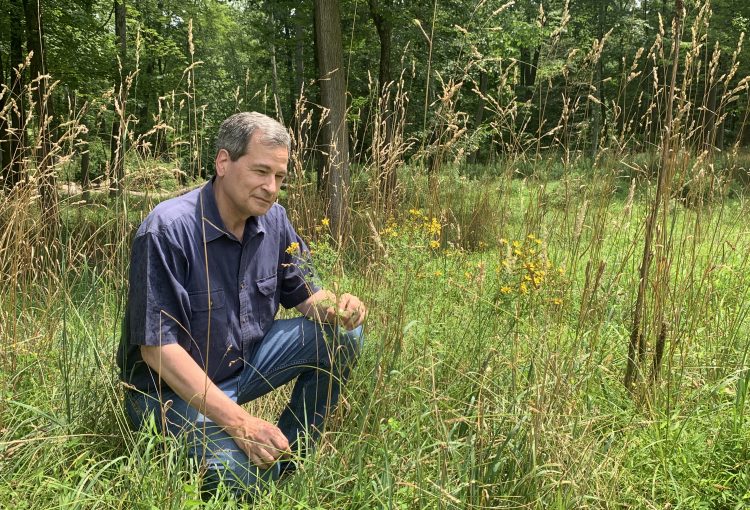
David Pogue pensively admires a meadow
Good Ideas Spread Like Wildflowers
Pogue hopes his landscape can inspire others. “With luck, it will become a model for neighbors,” he says. “Maybe they’ll say, wow, their yard is really pretty and they never have mowing going on… it will speak for itself.”
He also believes the work of Bedford 2030 has far-reaching importance. “I always say, changing your light bulbs to LED—sorry, that’s not going to fix the climate. You need to strike with larger entities… I feel like Bedford 2030 is trying to get an entire town effort going,” he says. “And one of my goals is to take the playbook that they’ve got going… and let other towns reproduce it.”
So what would he say to anyone curious about improving their yard, cutting costs, and creating a more sustainable landscape?
“If you have a smaller area you’d like to do natively to get more butterflies, whatever it is—it’s free. So what the hell?”
*Yes, microclover is non-native. But it’s not invasive—and in our view, getting off resource-guzzling turfgrass is a bigger win for the planet. Bonus: our backyard bunnies love it.