
Heat Pump 101 at the Healthy Home Academy
The Bedford 2030 Communications Team, aka The Ginger Gals—Harmony and Grace, visited our friend and board member Kevin Brenner at the Healthy Home Academy for a crash course on heat pumps, why someone would want one, and debunking some cold-weather myths.
We were delighted and surprised to walk into a large workshop, or “mad scientist laboratory” as Kevin calls it, with disassembled heat pumps, furnaces, and various other electrical doohickeys. Encountering someone who loves their job as much as Kevin does is a real treat. We kicked off our questions and show-and-tell with the basics that a homeowner might wonder about heat pumps.
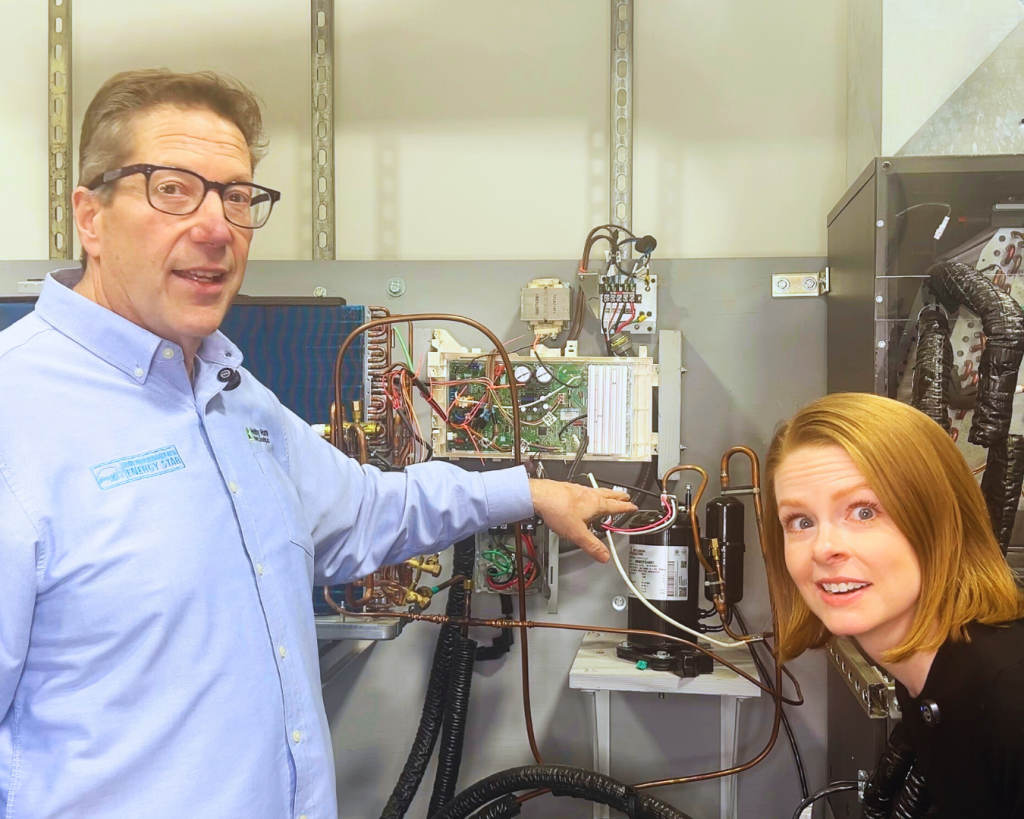
What is a heat pump, and how does it work?
Kevin Brenner, Healthy Home: It’s all in the name—it pumps heat from one area to another. For instance, in the summer it removes heat from your house, pumping it outside. That’s how a regular air conditioner works. [In winter], a heat pump can also take heat from outside, moving it inside.
What about when it’s 20 degrees outside?
KB: Think of heat as energy. There’s still energy outside at 20 degrees. A heat pump in winter functions just like an air conditioner, except the refrigerant flow is reversed. So, the electricity that you’re purchasing to run a heat pump only runs the components of the heat pump. It is not creating heat. That’s why heat pumps work so efficiently.
Harmony Dixon, Bedford 2030: It’s just moving heat.
How many heat pumps does a typical house need?
KB: It’s your home, and we’re gonna customize the solution based on your needs—and what the house scientifically tells us, like the heating load for your specific house.
Turns out, it depends! Every house is unique and requires different solutions for energy efficiency upgrades, like insulation, air sealing, heat pumps, and solar panels.
Healthy Home is an excellent choice for your free home energy audit (which includes no-cost scientific assessments like the blower door test, even if you don’t use their company for upgrade work). Bedford 2030’s Free Home Energy Coach can identify your home’s unique needs (before or after your energy audit with Healthy Home) and help you discover solutions to save energy and money.
Healthy Home is recommended by NYSERDA to perform no-cost home energy assessments. For the full list of approved contractors, please click here.
We know what you’re thinking—talk savings to me, Ginger Gals!
HD: Does it cost me less money to heat and cool my home with heat pumps than if I had a gas or oil system?
KB: Great question. Let’s give a reality check here. If you have natural gas in your house right now, which is a fossil fuel, and there are many reasons to replace that, the reality is natural gas is so cheap that you’re probably not going to save a whole bunch of money switching to a heat pump. If you’re on oil, propane, or even straight electric, you’ll save money because these heat pumps are so efficient.
HD: I’m using less electricity because it is more efficient. So it costs me less money to operate. And the primary reasons for switching are climate and health.
KB: That is correct.
What about government rebates and incentives?
KB: A lot of the opportunities are income-based. If you meet certain income requirements, you can actually get a heat pump for free or with low-interest financing.
KB: You can also get a $2,000 Inflation Reduction Act tax credit. You can get real money to put in a heat pump. In addition, the biggest chunk of change you can get for putting in a heat pump, if you don’t qualify for the free one, is from your utility. It’s called the Clean Heat Program.
Want to hear a joke? Is your furnace running? Yes? Then you’d better start planning its funeral because they always die at the worst possible moment.
KB: When boilers die, they die on Thanksgiving, they die on Christmas, they die on New Year’s Eve, they never die in April, right? They never die in October. They die when you need them the most. So, a great thing to do is to think about this preemptively and have a plan.
This is something Bedford 2030’s Free Home Energy Coach can help you with: making a plan. Plan for the inevitable, the upgrade, and the future for free by scheduling a Zoom call with Bob today.
Heat Pumps come in many sizes and “flavors,” which is why we always recommend talking to a building professional like Bob at Bedford 2030 or Kevin at Healthy Home to give you a realistic picture of your home’s status and potential to reduce the impacts of climate change and energy consumption (in most cases leading to energy cost savings for homeowners.)
There are many different flavors of heat pumps. What’s on the menu?
KB: Every heat pump system has at least one outdoor unit. On the inside, your flavors are the typical wall mount unit that people usually consider. But there are other types, like ceiling cassettes—great for kitchens where you have limited wall space. There are ducted systems, which are perfect if you have an open attic above your second floor or an open basement below your first floor. You could have a floor-mount unit, which is really a low wall-mount unit. Those are the big categories.
HD: That’s a large order. Thank goodness for you.
KB: Yes, I’m the waiter, and I can make a suggestion. And I’m not going to suggest the most expensive thing on the menu because my tip is not based on that.
HD: Heat pump sommelier.
KB: Exactly.
MYTH: Heat Pumps don’t work in cold weather. So we asked Kevin what kind of heat pumps homeowners in cold climates need.
KB: In New York, we should always use heat pump brands made for cold climates, like Mitsubishi (Kevin’s favorite.) LG, Daikin, and Samsung also have them.
HD: How cold do they go? You know I’m from Minnesota.
KB: I can tell you from real-world experience that I was at my home in Massachusetts, where it was negative 12 degrees as a low and got to a high of about 2, and there were no issues. They’re rated down to negative 13 degrees. It doesn’t get down to negative 13 here too often.
HD: What happens when it’s negative 20?
KB: Your heat pump will still work. It won’t have the same efficiencies that it has at 0, freezing, or 47 degrees above. But even at those cold temperatures, heat pumps are still more efficient than, let’s say, electric strip baseboards.
HD: So it won’t stop working even if it’s really cold, it just won’t work as well?
KB: It’s not a question of as well. You won’t notice the difference in your home. You’ll notice the difference in your electric bill. Heating your house when it’s 47 degrees outside, you won’t use as much electricity as you would when it was minus 20.
Fact: Heat Pumps are more efficient than ever, but that’s not the coolest thing about them.
KB: They’re really smart—do you know what they don’t do, Harmony?
HD: Math?
KB: No, they don’t. And they don’t burn fossil fuels. When I lived in Bedford, I had solar panels on my roof. I was heating and cooling my house for free because I was using that [solar] energy to power these heat pumps. It wasn’t creating heat but powering the compressor and the fans to distribute that heat to where I either wanted it or didn’t want it.
HD: So you’re heating your home and not the planet.
KB: That is exactly what we want to do.
Our Healthy Home Academy Heat Pump lesson thesis:
HD: So everything is customized to you as an individual. Your energy assessment will tell you about your home. Your utility will tell you what rebates and incentives are available to you, depending on where you live and how much your income is. And Kevin (and Bedford 2030’s Free Home Energy Coach) can help you figure out everything.
KB: That is correct.
HD: Is there anything you can’t do?
KB: I’m not great in the kitchen.
No matter your income, the quirks of your home, or where you are on your energy efficiency journey, there are free programs to help you get started. Take advantage of our Free Home Energy Coaching program today, or give Healthy Home a ring for your free energy assessment. We’re all here to help you and the planet!