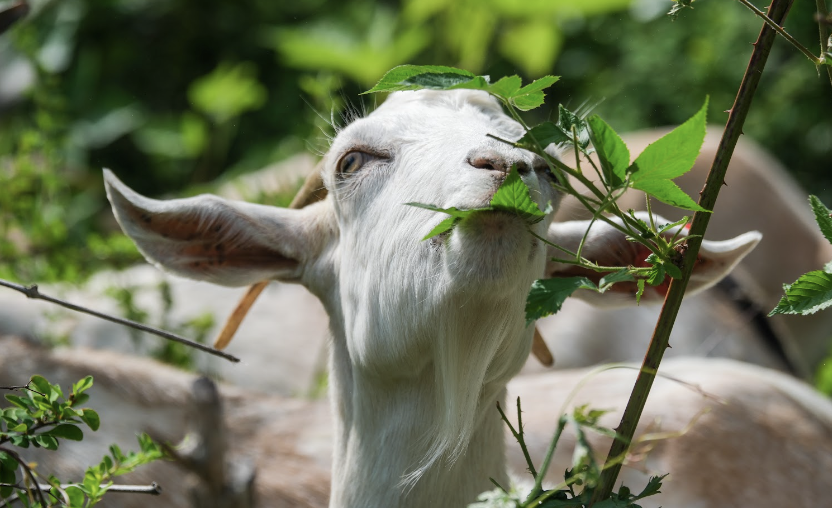
Fat and Sassy Goats have made their mark yet again at The Harvey School, with an appetite for destruction – of invasive vines, that is. Before the goats arrived last year, massive mounds of porcelain berry had overrun much of the school property along Route 22. This year, the goats continued to eat away at the highly invasive, woody, climbing vines that outcompete native plants and pollinators and choke the life from trees.
The idea to introduce goats as a natural solution to invasive removal was arrived at independently by Bill Knauer, Head of Schools at Harvey, and Midge Iorio, Executive Director at Bedford 2030. Both had read about this novel approach and were excited to give it a try. So they partnered on a pilot program and brought in Fat and Sassy Goats to supply the herd.
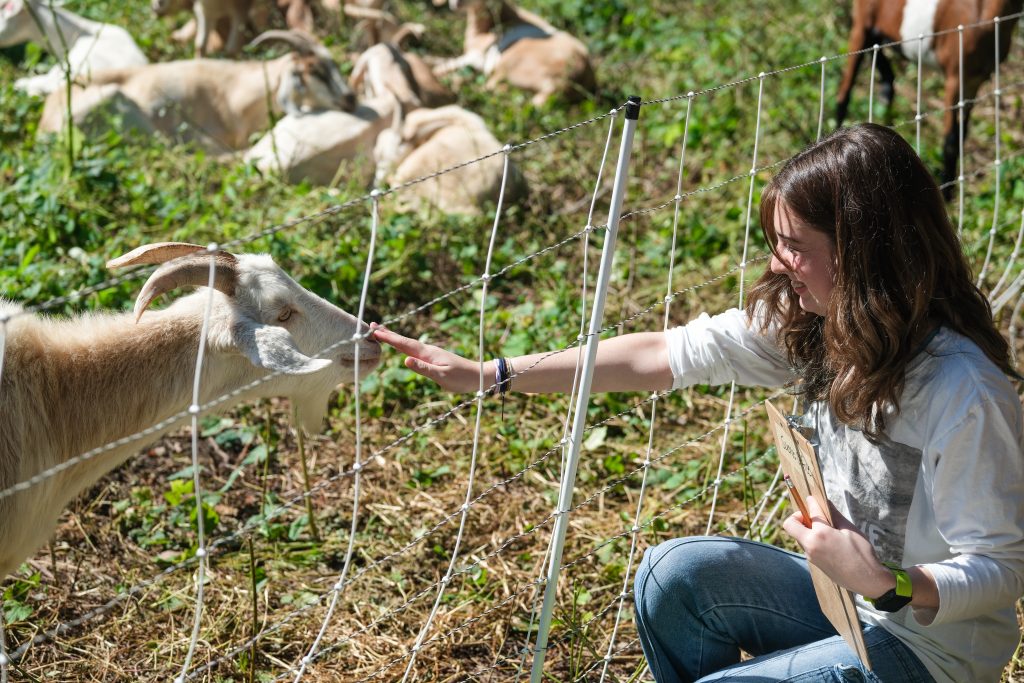
Photo by Abby Hassett for The Harvey School
Mr. Knauer is impressed with the efficiency of the goats; ten goats can clear an entire acre in thirty days. The educators at Harvey view this endeavor as a learning opportunity and continue to look at ways to incorporate it into the broader curriculum around sustainability. “Being a good neighbor and responsible steward of the land is important,” explained Bill. “I hope to see others adopt this land management approach.”
Biology teacher, Charlotte Franco recently incorporated this natural climate solution into her Ecology curriculum. “Harvey is fortunate to have access to lands that are great examples of local ecosystems. I brought my honors biology classes to see the goats in action as they help in the fight against invasive species. We talked about the differences between producers and consumers, how goats as ruminants are specially designed to digest plants high in cellulose, and how this form of invasive species management is more environmentally friendly than the alternatives. The students were tasked with collecting evidence and observations to help identify the species of invasive plants when we got back to the classroom. As an educator in science, I love to bring to life the material we learn in class whenever I can. Not only does this keep the students engaged, but it allows them to see how science literacy can help them navigate through life.”
Harvey’s next-door neighbor happens to be Midge Iorio of Bedford 2030, who has championed the adoption of targeted vegetation management by goats. This practice aligns with Bedford 2030’s mission and, specifically, its Rooted Solutions initiative, centered around natural solutions to climate change. Invasive plants are a threat to native trees and deep-rooted plants, which capture and store carbon. The typical approach to removing invasives involves chemicals and fossil fuel-powered equipment, both of which are associated with greenhouse gas emissions.
When Jenn Balch, and her partner Donald Arrant, of Fat and Sassy Goats assessed the land at Harvey this spring, they were encouraged to find a striking reduction in the prevalence of porcelain berry. She noted the many benefits of this natural approach: it is fossil fuel and chemical free, so it doesn’t destroy beneficial forms of life. In addition, goats naturally add organic matter which helps the soil retain water, adds nutrients and minerals, and improves soil quality. While the pilot is still ongoing, Jenn and Donald are hopeful that goats will offer a win-win solution. “Some native plants have appeared, including plenty of milkweed, which bodes well for monarch butterflies. I noticed a dragonfly and saw my first earthworm in the soil,” she said. “Life is coming back.”
Want more information about using goats as a Rooted Solution?